

Removing a gear, bearing, pulley, or other press-fit component from a shaft can be challenging without the correct tools. Many mechanics still rely on hammers, pry bars, or improvised methods, but these approaches often create unnecessary risks, including damaged shafts, cracked components, and personal injury.
A gear puller is designed to solve this problem by applying controlled pulling force. Instead of using uncontrolled impact force, a puller gradually separates the component from the shaft while maintaining alignment and protecting surrounding parts.
For professional automotive technicians, transmission rebuilders, and industrial maintenance teams, knowing how to use a gear puller correctly is essential for improving repair efficiency and preventing expensive component damage.
At BY (Baiyu Tools), we have focused on professional automotive repair tools for more than 20 years, providing gear pullers, bearing pullers, and customized OEM/ODM solutions for global customers. Through cooperation with workshops and tool distributors worldwide, BY understands that a reliable puller is not only about pulling force-it is about safe, controlled, and repeatable operation.
What Is a Gear Puller Used For?
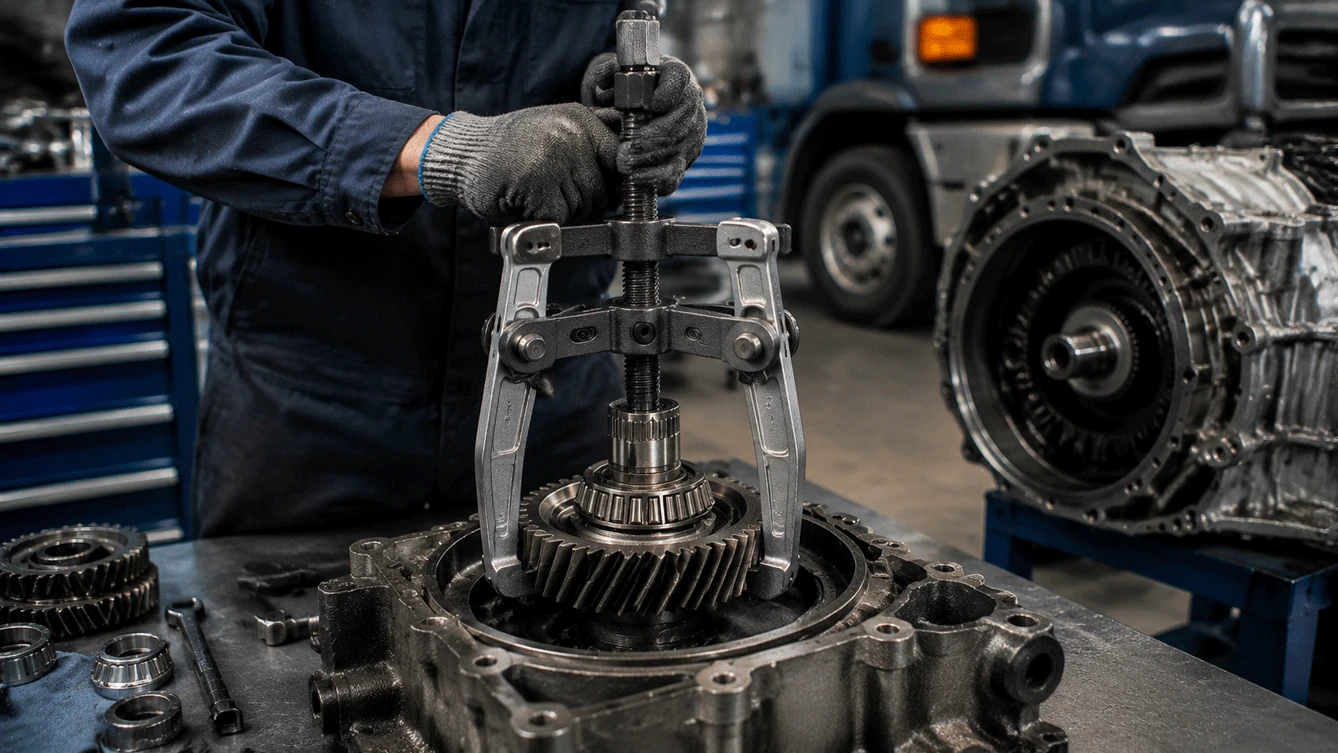
A gear puller is a mechanical extraction tool designed to remove components installed tightly on shafts through press fitting or interference fitting.
Common applications include:
Gear removal
Bearing removal
Pulley removal
Flywheel removal
Sprocket removal
Bushing removal
Coupling removal
Gear pullers are widely used in:
Automotive repair
Heavy-duty truck maintenance
Transmission rebuilding
Agricultural equipment service
Industrial machinery maintenance
A typical gear puller consists of three main parts:
Pulling jaws
Cross beam or yoke
Center forcing screw
The jaws grip the component while the forcing screw pushes against the shaft center. As the screw rotates, mechanical advantage converts turning force into controlled pulling force.
Step 1: Select the Correct Gear Puller
Before starting any removal job, choosing the correct puller is the most important step.
Using an undersized or unsuitable puller can cause:
Bent jaws
Slipping
Damaged components
Tool failure
Professional technicians should consider:
Component Size
Measure:
Gear diameter
Working depth
Shaft diameter
Available clearance
The puller must have enough reach and capacity.
Pulling Capacity
The required pulling force depends on:
Component size
Corrosion level
Press fit strength
Operating environment
Small automotive components may only require a standard mechanical puller.
Large truck transmission gears or industrial bearings may require hydraulic assistance.
Two-Jaw vs Three-Jaw Puller
Two-Jaw Gear Puller
Advantages:
Works in limited spaces
Easier positioning
Compact design
Suitable for:
Small gears
Tight engine compartments
Limited access applications
Three-Jaw Gear Puller
Advantages:
Better balance
More even force distribution
Reduced slipping risk
Suitable for:
Bearings
Large gears
Professional workshop applications
For general workshop use, three-jaw pullers are often preferred because the additional jaw improves stability.
Step 2: Inspect the Gear Puller Before Use
Before applying force, inspect the tool carefully.
Check:
Cracks
Bent arms
Damaged threads
Worn jaws
Lubrication condition
Never use a damaged puller.
A failed puller under high load can create safety hazards.
Professional workshops should regularly maintain pullers because they are high-force tools.
Step 3: Position the Puller Correctly
Correct positioning determines whether the removal process will succeed.
Align the Center Screw
The forcing screw must be aligned with the shaft center.
Incorrect alignment may cause:
Side loading
Uneven pulling force
Shaft damage
Secure the Jaws
The jaws should:
Fully contact the component
Grip firmly
Remain evenly positioned
Avoid situations where:
One jaw carries most of the load
The jaws sit at different depths
The puller is tilted
Proper alignment is one of the most important safety factors when using a gear puller.
Step 4: Apply Pulling Force Gradually
Once the puller is installed:
Tighten the forcing screw slowly.
Monitor the component movement.
Check jaw position continuously.
Continue increasing force gradually.
Do not:
Hit the puller with a hammer unless specifically designed for impact use
Apply sudden force
Extend the wrench excessively
Controlled force protects:
Gear teeth
Shafts
Bearings
Housings
Step 5: Use Penetrating Oil When Necessary
Some components become difficult to remove because of:
Rust
Corrosion
Long service periods
Heat exposure
Before increasing pulling force:
Apply penetrating lubricant around the connection area.
Allow time for penetration.
This reduces the required extraction force.
Step 6: Monitor During Removal
During the pulling process, observe:
Gear movement
Jaw position
Tool deformation
Shaft condition
Stop immediately if:
The jaws start slipping
The tool becomes misaligned
Unusual deformation appears
Never continue forcing a poorly positioned puller.
Common Mistakes When Using a Gear Puller
Using the Wrong Size Puller
A small puller may fail under excessive load.
Solution:
Choose a puller with sufficient capacity.
Pulling from the Wrong Position
Incorrect jaw placement can damage the component.
Solution:
Grip behind the strongest structural area.
Applying Impact Force
Hitting a standard puller with a hammer may damage the tool.
Solution:
Use a hydraulic puller when higher force is required.
Ignoring Alignment
A tilted puller creates uneven stress.
Solution:
Keep the center screw aligned with the shaft.
Using Damaged Tools
Worn threads and cracked arms reduce safety.
Solution:
Inspect tools before every high-load operation.
Mechanical Gear Puller vs Hydraulic Gear Puller
Mechanical Gear Puller
Advantages:
Simple structure
Lower cost
Easy maintenance
Suitable for daily repairs
Applications:
Automotive workshops
General maintenance
Medium-size components
Hydraulic Gear Puller
Advantages:
Higher pulling force
Less manual effort
Suitable for large components
Applications:
Heavy truck repair
Industrial equipment
Large bearings
For professional workshops handling heavy-duty applications, hydraulic pullers can significantly improve efficiency.
Gear Puller Applications in Automotive and Heavy-Duty Repair
Engine Repair
Used for:
Timing gears
Pulleys
Harmonic balancers
Transmission Repair
Used for:
Transmission gears
Bearings
Synchronizer components
Heavy Truck Maintenance
Used for:
Gearbox components
Differential parts
Large bearings
Commercial vehicle repair requires tools capable of handling larger components and higher extraction forces.
Why Choose BY Gear Pullers?
Professional technicians need tools that provide:
Stable pulling force
Accurate alignment
Long service life
Reliable performance
BY (Baiyu Tools) manufactures professional puller solutions including:
Gear pullers
Bearing pullers
Pulley pullers
Hydraulic puller sets
Customized OEM/ODM puller solutions
With manufacturing experience, quality control systems, and global export experience, BY supports distributors, repair workshops, and automotive tool brands with professional extraction solutions.
For workshops requiring customized products, BY provides OEM services including:
Logo customization
Packaging solutions
Product modification
Application-specific designs
Frequently Asked Questions
Can a gear puller remove a bearing?
Yes. Many gear pullers are designed for removing bearings, gears, pulleys, and similar press-fit components when the correct jaws and capacity are selected.
Is a three-jaw puller better than a two-jaw puller?
A three-jaw puller usually provides better stability and force distribution, while a two-jaw puller works better in areas with limited access.
When should I use a hydraulic gear puller?
Hydraulic pullers are recommended for large, seized, or heavy-duty components where manual pulling force is insufficient.
Conclusion
Using a gear puller safely requires more than simply tightening a screw. Correct tool selection, proper alignment, gradual force application, and regular inspection are essential for successful component removal.
For professional mechanics, a quality gear puller improves repair efficiency while protecting expensive parts from unnecessary damage.
Whether working on automotive engines, transmissions, heavy-duty trucks, or industrial machinery, choosing the right extraction tool allows technicians to complete difficult removal jobs faster, safer, and more reliably.
With decades of experience in automotive repair tools, BY (Baiyu Tools) continues to provide professional gear puller solutions designed for demanding workshop environments worldwide.


