


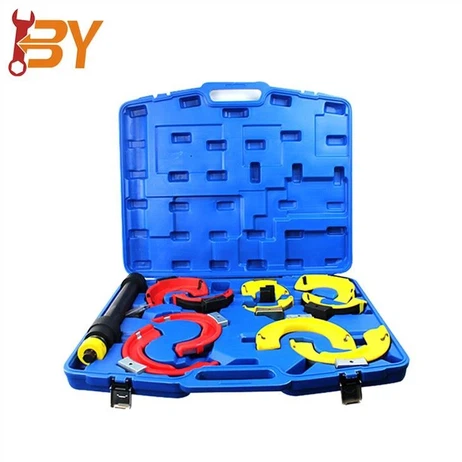
Suspension systems are designed to absorb shocks and keep vehicles stable on the road. At the heart of every suspension setup is the coil spring, which holds enormous tension even when the car is lifted.
A suspension spring compressor allows technicians to compress and control that spring safely during repairs or replacements. But when used incorrectly, it can become one of the most dangerous tools in a workshop.
Here are the top safety tips every mechanic should follow to use a spring compressor properly-and protect both themselves and their equipment.
1. Always Inspect the Tool Before Use
Before starting any job, inspect your spring compressor carefully:
Look for bent, cracked, or worn hooks or jaws.
Check the threaded rods or hydraulic cylinders for corrosion or damage.
Ensure all locking pins and safety latches are in place.
Never use a damaged spring compressor-it may fail under load, releasing the spring violently.
✅ Pro Tip: Replace worn components immediately or invest in a professional-grade unit from a reputable brand like Baiyu Tools for guaranteed safety.
2. Use the Correct Tool for the Job
Not all spring compressors are the same. Using the wrong type for the vehicle or spring design can cause instability.
| Type | Best For | Description |
|---|---|---|
| External Compressor | Standard suspension coils | Hooks attach outside the spring. |
| Internal Compressor | Tight or limited space setups | Compresses from inside the coil. |
| Hydraulic Compressor | Heavy-duty and professional use | Uses hydraulic force for smooth, even pressure. |
| MacPherson Strut Compressor | Front strut assemblies | Designed for safety and precision on strut units. |
Always match the compressor to the suspension type-especially on SUVs, trucks, or performance cars, which use stronger springs.
3. Position the Tool Evenly and Securely
Uneven compression is one of the most common causes of accidents.
Position both hooks or jaws directly opposite each other.
Make sure each hook seats firmly in the spring coil-not just partially.
Keep the compressor aligned parallel to the spring axis.
As you compress, alternate between sides in small, even turns to prevent twisting or slippage.
⚠️ Never use power tools (like an impact wrench) on manual compressors. The sudden torque can overload the threads or cause uneven pressure.
4. Compress Slowly and Smoothly
The key to safety is control. Whether mechanical or hydraulic, always compress the spring gradually:
Tighten or pump slowly to avoid jerking the spring.
Stop immediately if you hear creaking, slipping, or metal strain.
Maintain a safe distance from the spring's axis during operation.
Remember, a compressed spring can store tons of force-treat it with the same caution as a loaded weapon.
5. Keep a Safe Working Distance
Never position your body in line with the compressed spring.
If the compressor or hook slips, the spring can release suddenly with enough power to cause serious injury.
Stand to the side, not directly in front.
Use a protective barrier or shield if possible.
Keep bystanders and tools away from the danger zone.
Personal protective equipment (PPE) is non-negotiable:
✅ Safety glasses
✅ Mechanic gloves
✅ Steel-toed boots
6. Release Tension Gradually
Once repairs are complete, release the spring tension slowly and evenly.
Alternate between both sides of the compressor.
Make sure the spring is properly seated before fully releasing.
Never remove the compressor until all tension is released.
A sudden release can cause the spring to jump or rotate unexpectedly, damaging nearby components.
7. Regular Maintenance and Storage
A safe spring compressor is a well-maintained one:
Clean threads and lubricate them regularly to prevent friction wear.
Check hydraulic compressors for oil leaks and maintain correct fluid levels.
Store the tool in a dry, clean area, away from humidity and dust.
At Baiyu Tools, all our spring compressors are built with corrosion-resistant coatings and reinforced materials-ensuring long-term safety and reliability.
8. Invest in Quality Equipment
Low-cost or counterfeit spring compressors are often made from weak materials that can fail under load.
Professional workshops should always invest in forged steel or CNC-machined compressors rated for heavy use.
Baiyu Tools provides a full range of:
Hydraulic spring compressors for heavy-duty applications.
Manual and external types for compact workshop use.
OEM & ODM customization for tool distributors and professional brands.
Each tool is load-tested and engineered for safety, stability, and precision.
Conclusion
A suspension spring compressor is one of the most powerful-and potentially dangerous-tools in a mechanic's workshop.
By following proper inspection, positioning, and operation techniques, you can perform suspension repairs efficiently and safely.
For professional mechanics and distributors seeking reliable, precision-built compressors, Baiyu Tools offers trusted solutions that combine strength, safety, and innovation-helping you work smarter and stay protected every day.


