

A harmonic balancer puller kit may look like a relatively simple collection of puller arms, forcing screws, rods, bolts, and adapters. In professional engine repair, however, small differences in these components can have a major impact on fitment, removal efficiency, and the risk of damaging the crankshaft or harmonic damper.
That makes choosing the right kit more complicated than simply comparing the number of pieces in the case.
For a professional mechanic, workshop owner, fleet maintenance team, or automotive tool distributor, the more useful questions are:
Which engines can the kit actually service?
How strong is the forcing screw?
Does it include the correct adapters and forcing rods?
Can it work in a restricted engine compartment?
Is it intended only for removal, or can it also support installation?
Is the puller designed for occasional use or repeated professional service?
The short answer is that a professional harmonic balancer puller kit should combine correct vehicle coverage, a strong and accurately machined forcing system, secure engagement, suitable working clearance, durable materials, and organized accessories.
This guide explains the most important features to evaluate before purchasing a harmonic balancer puller kit and why they matter in real engine repair.
At BY (Baiyu Tools), harmonic balancer pullers form part of a broader automotive specialty tool range covering engine service, bearing removal, gear and pulley extraction, wheel bearing service, suspension, brakes, and other professional repair applications. BY also supports OEM and ODM development for distributors and automotive tool brands that require different tool configurations for their target markets.
What Is a Harmonic Balancer Puller Kit?
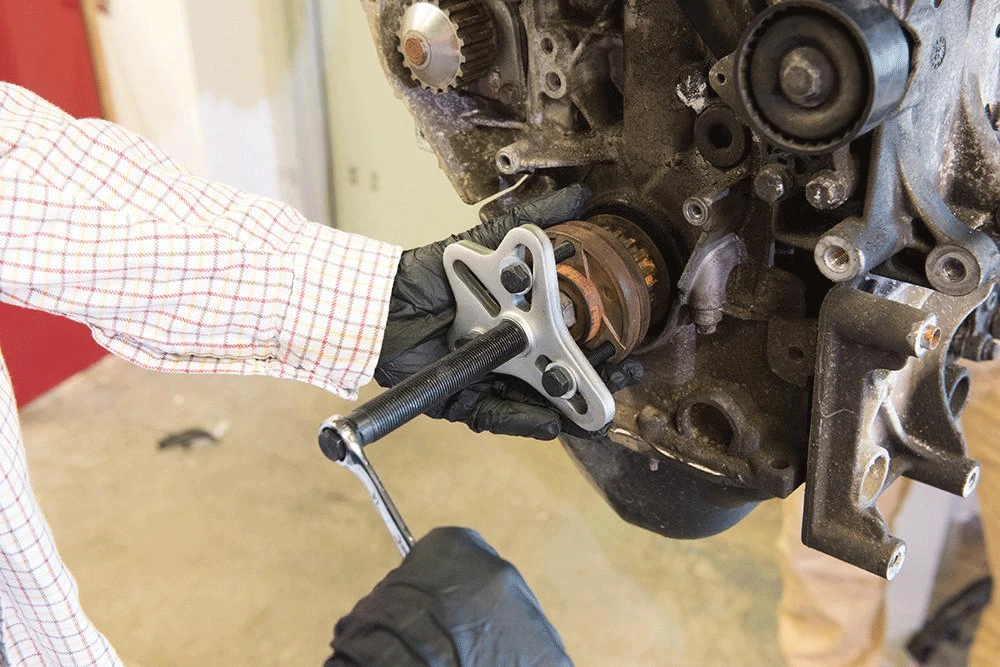
A harmonic balancer puller kit is a specialized tool system used to remove the harmonic balancer, vibration damper, or crankshaft pulley from an engine crankshaft.
Depending on the design, a kit may contain:
Puller yoke or puller body
Adjustable pulling jaws
Center forcing screw
Forcing rods
Centering adapters
Metric and SAE bolts
Extensions
Installation accessories
Storage case
The basic principle is straightforward: the puller connects to or grips the harmonic balancer while the forcing mechanism applies controlled force against the crankshaft centerline.
The objective is not simply to generate maximum force. It is to generate the right force in the right direction.
A well-matched tool helps the balancer move outward along the crankshaft axis while minimizing side loading and unnecessary stress on the crankshaft, pulley hub, seals, and surrounding engine components.
Why Does Puller Quality Matter in Professional Engine Repair?
Harmonic balancers can become difficult to remove after years of operation because of interference fit, corrosion, repeated heat cycles, contamination, and long-term mechanical loading.
When the proper puller is unavailable, technicians may be tempted to use pry bars, hammers, or unsuitable general-purpose pullers.
That can lead to:
Damaged crankshaft threads
Distorted pulleys
Damaged keyways
Cracked or separated harmonic dampers
Damaged front crankshaft seals
Timing cover damage
Additional repair time
A dedicated puller is designed to apply more controlled and centered force. This is especially important in professional workshops where the same tool may be used repeatedly and one damaged engine component can cost far more than the puller itself.
Feature 1: Check Vehicle and Engine Compatibility First
Compatibility should be the first consideration-not the number of pieces in the case.
Different harmonic balancers may require different:
Mounting patterns
Thread sizes
Pulling points
Forcing rod lengths
Working depths
Clearances
Before buying a kit, identify the vehicles and engines your workshop services most frequently.
For a Multi-Brand Workshop
A universal kit with several adapters, bolt sizes, and forcing rods generally provides better coverage.
This is particularly useful for independent garages that regularly service different passenger cars, SUVs, pickups, and light commercial vehicles.
For a Specialized Workshop
If a large percentage of your work involves the same engine family, a vehicle-specific tool can offer faster setup and more precise fitment.
The correct question is therefore not:
"How many vehicles does this puller fit?"
It is:
"Does this puller cover the engines that generate most of my workshop's actual repair work?"
Feature 2: Pay Close Attention to the Forcing Screw
The forcing screw is one of the most heavily loaded components in a harmonic balancer puller.
During removal, it converts technician input into axial extraction force.
A professional forcing screw should provide:
High material strength
Accurate threads
Smooth operation
Good resistance to deformation
Reliable alignment under load
Poorly manufactured threads can increase friction, make force application inconsistent, or fail under heavy loading.
For frequent professional use, look for a hardened or heat-treated screw with accurately machined threads rather than judging the tool only by its external appearance.
Why Centering Matters
The forcing screw should remain aligned with the crankshaft centerline.
If the tool begins pulling at an angle, the technician may experience:
Uneven loading
Difficult rotation
Balancer binding
Increased risk of crankshaft or component damage
A well-designed centering point, swivel, or forcing rod system helps maintain alignment as load increases.
Feature 3: Evaluate the Puller Body or Jaw Design
Not every harmonic balancer uses the same removal method.
Common puller designs include:
Bolt-Type or Yoke Pullers
These connect to threaded mounting holes in the balancer.
They can provide stable, controlled pulling when the balancer has appropriate threaded attachment points.
A yoke capable of accommodating multiple hole arrangements can increase versatility.
Three-Jaw Pullers
Three-jaw harmonic balancer pullers grip the component mechanically rather than relying exclusively on threaded mounting holes.
Their main advantages include:
Fast setup
Adjustable gripping
Useful compatibility on appropriate balancer designs
Good access in certain engine compartments
However, mechanics must confirm that the jaws are gripping an appropriate structural area. Not every harmonic balancer should be pulled from its outer ring.
The correct design depends on the construction of the component being removed.
Feature 4: Look at the Forcing Rod and Adapter Selection
A professional kit should provide enough accessory variation to reach different crankshaft and balancer configurations.
Useful components may include:
Multiple forcing rod lengths
Centering adapters
Different threaded bolts
Metric hardware
SAE hardware
Extensions
A wider selection does not automatically make a kit better.
The accessories need to correspond to real vehicle applications.
For example, BY's professional harmonic balancer puller range includes configurations using multiple forcing rods to accommodate different working depths, while other kits use yokes and multiple bolt sizes for different mounting patterns.
Feature 5: Consider Working Clearance
One feature that is often overlooked when purchasing a puller is the amount of space available in front of the engine.
Modern engine compartments can be crowded with:
Radiators
Cooling fans
Crossmembers
Hoses
Air-conditioning components
Electrical systems
A puller may have sufficient capacity but still be impractical if it requires too much axial working space.
For professional workshops, compact tool geometry can significantly reduce disassembly time.
Some 3-jaw harmonic balancer puller configurations are specifically designed to operate in restricted engine compartments and can reduce the need to remove additional front-end components simply to create tool clearance. BY's current harmonic balancer puller range includes this type of compact application.
Feature 6: Examine Material and Heat Treatment
Pullers operate under substantial mechanical load.
Professional-grade components commonly use:
Carbon steel
Alloy steel
Heat-treated steel
Hardened threaded components
Material specification matters, but material alone does not determine tool quality.
Manufacturing consistency, heat treatment, machining accuracy, dimensional control, and final inspection are equally important.
BY, for example, lists heat-treated steel construction across its harmonic balancer puller products, including AISI 1045/45# medium-carbon-steel configurations, together with surface treatments intended to improve wear and corrosion resistance.
For B2B buyers, asking the supplier about material and manufacturing control can therefore be more useful than simply comparing product photos.
Feature 7: Check Whether the Kit Supports Removal and Installation
Many buyers focus entirely on removal.
But once the harmonic balancer has been removed and the repair is complete, it must be installed correctly.
Trying to force the balancer back onto the crankshaft using an inappropriate method can damage:
Crankshaft threads
Balancer hub
Keyway
Front seal
Alignment
For workshops performing regular engine service, a combined puller and installer kit may therefore provide better value than a removal-only system.
When comparing kits, ask:
Does this kit only remove the balancer, or does it provide the components needed for controlled installation as well?
This is particularly relevant for engine rebuilders and high-volume repair facilities.
Feature 8: Do Not Ignore the Storage Case
A storage case may seem secondary to tool performance, but in a busy workshop it affects efficiency.
A professional harmonic balancer kit can contain many:
Bolts
Adapters
Rods
Washers
Small fittings
Without organized storage, components are easily lost.
A molded case with dedicated positions helps technicians:
Identify missing pieces
Find the correct adapter faster
Keep components protected
Transport the kit between work areas
Reduce setup time
For fleet maintenance and mobile repair, this becomes even more important.
Feature 9: Consider Repair Frequency
The best kit for an occasional repair is not necessarily the best kit for a professional engine shop.
Occasional Workshop Use
Prioritize:
Essential compatibility
Simple configuration
Reasonable accessory range
General Professional Workshop
Prioritize:
Multi-brand coverage
Strong forcing screw
Multiple adapters
Organized storage
Replaceable components
High-Volume Engine Specialist
Prioritize:
Fast setup
Vehicle-specific coverage where appropriate
Removal and installation capability
Replacement hardware availability
Long-term durability
Fleet or Commercial Vehicle Workshop
Prioritize:
Engine platform compatibility
Heavy-duty construction
High repeatability
Efficient standardized procedures
The correct purchasing decision should be based on lifetime workshop use rather than the lowest initial purchase price.
Feature 10: Consider Supplier and OEM Support
For an individual mechanic, tool performance is usually the main concern.
For distributors, wholesalers, and private-label automotive tool companies, the supplier itself becomes another part of the buying decision.
Important B2B factors include:
Consistent specifications
Quality inspection
OEM branding
Customized packaging
Product development capability
Replacement parts
Application support
BY (Baiyu Tools) supplies automotive specialty tools for global aftermarket customers and supports OEM/ODM development. Its harmonic balancer puller range includes multiple tool structures rather than a single universal design, allowing customers to select configurations according to market applications.
This is particularly useful for distributors building a broader engine-service-tool category instead of sourcing only one individual puller.
Quick Harmonic Balancer Puller Kit Buying Checklist
Before ordering a kit, check the following:
| Buying Factor | What to Check | Why It Matters |
|---|---|---|
| Vehicle coverage | Engine and model compatibility | Determines actual workshop usefulness |
| Puller design | Yoke, bolt-type, jaw-type | Must match balancer construction |
| Forcing screw | Material, threads, strength | Carries the main extraction load |
| Forcing rods | Length and quantity | Supports different working depths |
| Adapters | Metric/SAE and application coverage | Expands compatibility |
| Material | Steel grade and heat treatment | Affects durability |
| Clearance | Overall working dimensions | Important in tight engine bays |
| Installation support | Puller only or puller/installer | Determines complete service capability |
| Storage | Organized molded case | Prevents lost components |
| Supplier support | QC, OEM/ODM, replacement parts | Important for professional/B2B purchasing |
Universal Kit or Vehicle-Specific Kit?
For many workshops, this is the final buying decision.
Choose a Universal Kit When:
You repair many vehicle brands.
Your engine mix changes frequently.
You need broad coverage from one kit.
You want to control specialty tool inventory.
Choose a Vehicle-Specific Tool When:
You repeatedly service the same engine family.
Setup speed matters.
Precise application fit is a priority.
The repair volume justifies a dedicated tool.
For many professional workshops, the most practical strategy is to start with a high-quality universal kit and add vehicle-specific tools for the engine platforms serviced most frequently.
Frequently Asked Questions
What should I look for in a professional harmonic balancer puller kit?
Prioritize vehicle compatibility, forcing screw quality, correct puller geometry, adapter and forcing rod coverage, material strength, working clearance, and organized storage. For frequent engine service, removal and installation capability is also worth considering.
Is a 3-jaw harmonic balancer puller better than a bolt-type puller?
Neither design is universally better. The correct choice depends on the harmonic balancer construction and approved pulling points. Bolt-type pullers work well when suitable threaded holes are available, while compatible 3-jaw designs can provide quick installation and useful access on other applications.
Can I use a normal 3-jaw gear puller on a harmonic balancer?
Not automatically. General-purpose 3-jaw pullers grip the outside of a component, and pulling from an unsuitable area of a harmonic balancer can damage the pulley or damping structure. A dedicated harmonic balancer tool matched to the component is preferable for professional engine service.
Is a more expensive harmonic balancer puller always better?
No. The best professional tool is the one that combines suitable application coverage, reliable construction, correct pulling geometry, and durability for your expected repair volume.
Do I need a harmonic balancer installer as well?
If your workshop regularly performs timing service, front crankshaft seal replacement, or engine rebuilding, installation capability is highly useful. Controlled installation can reduce stress on crankshaft threads and help ensure correct balancer seating.
Conclusion
Buying a professional harmonic balancer puller kit should not be based on piece count or price alone.
The most important factors are application compatibility, pulling geometry, forcing screw quality, accessory coverage, material strength, working clearance, and long-term workshop reliability.
For a general automotive workshop, a versatile universal kit can provide broad coverage and good value. For specialists working repeatedly on the same engines, dedicated vehicle-specific tools can improve setup speed and productivity.
And for distributors or private-label automotive tool brands, supplier manufacturing capability and customization support should also form part of the purchasing decision.
BY (Baiyu Tools) offers harmonic balancer pullers alongside a broader range of professional engine, bearing, pulley, gear, and automotive specialty tools, with OEM/ODM options for global aftermarket customers.
The objective is ultimately simple: choose a tool that lets the technician remove the harmonic balancer efficiently while protecting the crankshaft and surrounding engine components.


