

Many mechanics assume that a harmonic balancer can be removed using any type of puller. After all, both a harmonic balancer puller and a 3-jaw puller are designed to remove press-fitted components from shafts. However, while they may appear similar at first glance, they are designed for completely different applications.
Choosing the wrong puller can result in:
Cracked harmonic balancers
Bent pulleys
Damaged crankshaft threads
Oil seal failure
Broken timing covers
Expensive engine repairs
For professional mechanics, understanding the difference between a harmonic balancer puller and a 3-jaw puller is essential for safe and efficient engine service.
What Is a Harmonic Balancer Puller?
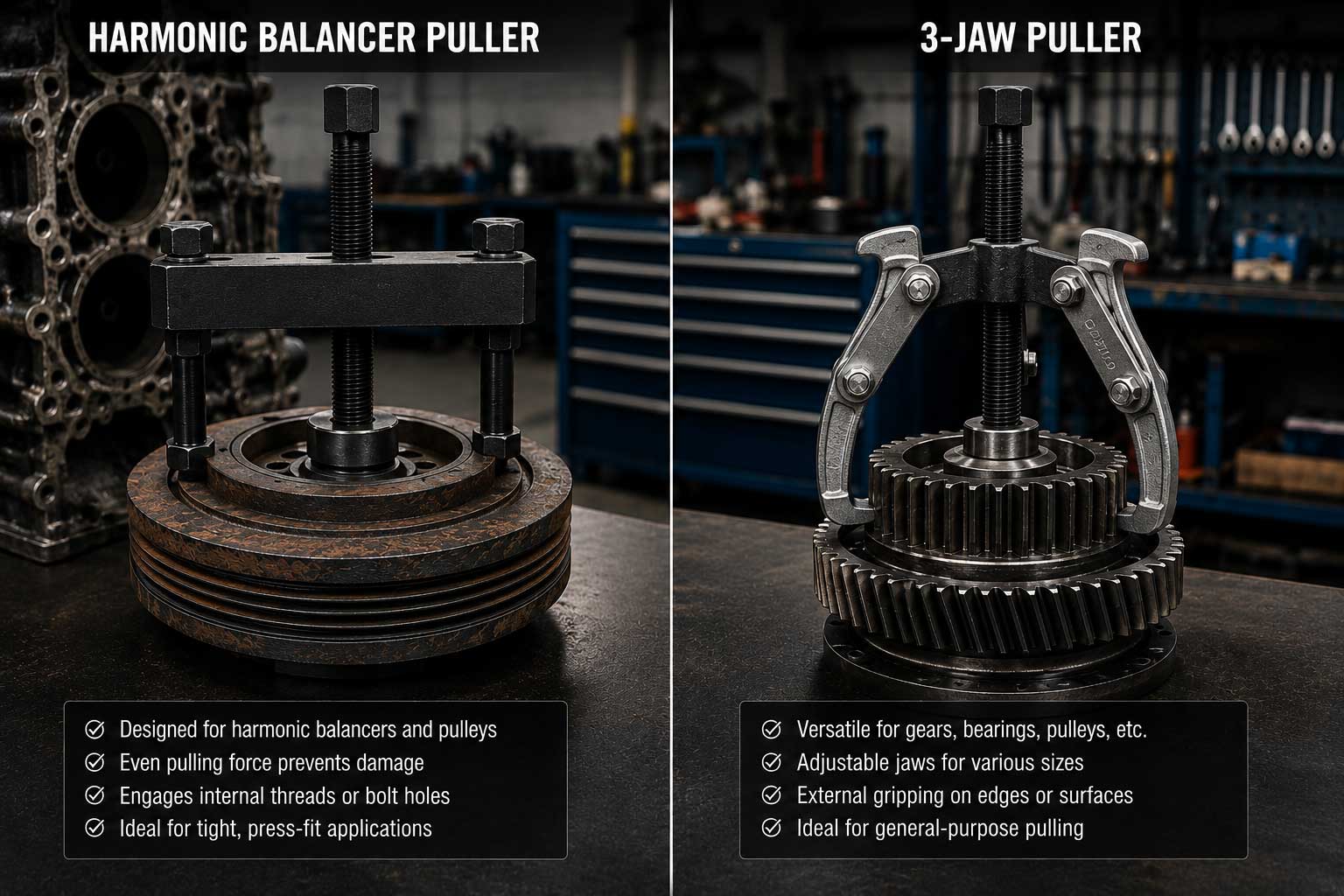
A harmonic balancer puller is a specialized tool designed specifically for removing harmonic dampers and crankshaft pulleys from internal combustion engines.
Unlike conventional pullers, it attaches directly to threaded holes in the harmonic balancer and uses a center forcing screw to apply straight, controlled pulling force against the crankshaft. This design minimizes side loading and protects the balancer, crankshaft, and surrounding engine components.
A typical harmonic balancer puller kit includes:
Puller plate
Center forcing screw
Multiple threaded bolts
Metric and SAE adapters
Installation hardware
The purpose of this design is to safely remove a harmonic balancer without damaging its internal damping structure or the crankshaft assembly.
What Is a 3-Jaw Puller?
A 3-jaw puller is a general-purpose pulling tool used throughout automotive, industrial, and heavy equipment maintenance.
Instead of bolting directly to the component, a 3-jaw puller uses three adjustable arms that grip the outside or inside of a part while a forcing screw pushes against the shaft center.
3-jaw pullers are commonly used for:
Bearings
Gears
Pulleys
Bushings
Sprockets
Wheel hubs
Their adjustable design makes them extremely versatile, which is why most workshops keep several sizes available.
However, versatility does not mean suitability for every application.
Why Harmonic Balancers Are Different
A harmonic balancer is not just a pulley.
A harmonic balancer is actually a vibration control device mounted on the crankshaft to reduce torsional vibration generated during engine operation. It is designed as an interference fit on the crankshaft and often contains rubber or elastomer damping material that absorbs vibration energy.
Modern harmonic balancers typically include:
Inner hub
Outer inertia ring
Rubber damping element
Pulley grooves
Because the balancer contains sensitive damping material and must remain precisely balanced, applying uneven pulling force can cause permanent damage.
This is where the difference between puller types becomes critical.
How a Harmonic Balancer Puller Works
A harmonic balancer puller removes the balancer by applying force evenly through threaded mounting holes.
The process works as follows:
Bolts thread into the balancer
Puller plate attaches securely
Center forcing screw presses against crankshaft center
Balancer moves outward evenly
Advantages include:
Even pulling force
Minimal side loading
Protection of damping material
Protection of crankshaft threads
Reduced risk of pulley distortion
Because force is distributed evenly across the balancer, the risk of damage is extremely low when used correctly.
How a 3-Jaw Puller Works
A 3-jaw puller works differently.
The puller's three arms grab the outer edge of the component while a center screw pushes against the shaft.
Advantages include:
Fast setup
Wide compatibility
Adjustable design
Multiple applications
This design works extremely well for:
Bearings
Gears
Bushings
Standard pulleys
However, because force is applied from the outside edge, side loading can occur.
For many components this is acceptable.
For harmonic balancers, it often is not.
Key Difference #1: Pulling Force Distribution
This is the most important difference.
Harmonic Balancer Puller
Force is applied:
Through threaded holes
Across the puller plate
Directly along the crankshaft centerline
Result:
Even pressure
Controlled removal
Minimal distortion
3-Jaw Puller
Force is applied:
Through external gripping jaws
At multiple edge contact points
Result:
Uneven loading
Increased stress
Higher risk of deformation
For vibration dampers, force distribution matters tremendously.
Key Difference #2: Risk of Damaging the Balancer
Modern harmonic balancers often contain bonded rubber damping elements.
Excessive side force can cause:
Rubber separation
Hub distortion
Outer ring movement
Imbalance
Once the damping system is damaged, the balancer may no longer control crankshaft vibration effectively.
A damaged harmonic balancer can lead to:
Increased vibration
Premature bearing wear
Crankshaft fatigue
Engine reliability issues
A harmonic balancer puller significantly reduces these risks.
Key Difference #3: Crankshaft Protection
Crankshaft repair is expensive.
A dedicated harmonic balancer puller protects:
Crankshaft snout
Internal threads
Keyways
Seal surfaces
Because the forcing screw remains centered, pulling force stays aligned with the crankshaft axis.
A misaligned 3-jaw puller may create:
Side loading
Shaft scoring
Thread damage
Keyway wear
Professional engine builders rarely risk this on modern engines.
Key Difference #4: Compatibility
Harmonic Balancer Pullers
Best for:
Harmonic balancers
Crankshaft dampers
Crank pulleys
Timing service
Engine rebuilding
3-Jaw Pullers
Best for:
Bearings
Gears
Bushings
Sprockets
Industrial pulleys
While some older harmonic balancers can technically be removed with a 3-jaw puller, modern engine designs generally favor dedicated pullers.
Can a 3-Jaw Puller Be Used on a Harmonic Balancer?
The short answer is:
Sometimes, but it is rarely recommended.
A 3-jaw puller may work on:
Older engines
Solid steel pulleys
Non-damped assemblies
However, most modern harmonic balancers contain sensitive damping structures and require controlled removal methods.
Using a 3-jaw puller increases the risk of:
Balancer damage
Crankshaft damage
Seal damage
Pulley deformation
For professional repair work, the risk usually outweighs the convenience.
When Should You Use a Harmonic Balancer Puller?
A dedicated harmonic balancer puller should always be used when:
Replacing timing chains
Replacing timing belts
Servicing front crankshaft seals
Rebuilding engines
Performing crankshaft repairs
Working on diesel engines
Servicing GM LS engines
Servicing Ford modular engines
In these situations, protecting the crankshaft and balancer is more important than saving a few minutes during setup.
When Should You Use a 3-Jaw Puller?
A 3-jaw puller remains one of the most valuable tools in any workshop.
Ideal applications include:
Bearing removal
Gear removal
Pulley removal
Hub removal
Industrial equipment repair
Because of their versatility, professional mechanics often use 3-jaw pullers daily.
The key is understanding when they are appropriate-and when they are not.
What Professional Mechanics Prefer
Most professional repair facilities and engine builders use both tools.
A typical workshop will have:
Multiple 2-jaw pullers
Multiple 3-jaw pullers
Dedicated harmonic balancer puller kits
Vehicle-specific balancer pullers
Each tool serves a different purpose.
Experienced technicians rarely substitute a 3-jaw puller for a harmonic balancer puller when working on modern engines.
The potential repair cost is simply too high.
Conclusion
Although harmonic balancer pullers and 3-jaw pullers are both designed to remove press-fitted components, they are not interchangeable tools.
A harmonic balancer puller is specifically engineered to remove crankshaft dampers safely by applying controlled, centered force through threaded mounting points. This protects the harmonic balancer, crankshaft, seals, and timing components.
A 3-jaw puller is a versatile general-purpose tool that excels at removing bearings, gears, pulleys, and hubs, but it applies force differently and can create excessive stress on modern harmonic balancers.
For professional engine repair, timing service, diesel maintenance, and engine rebuilding, a dedicated harmonic balancer puller remains the safest and most effective choice.


