


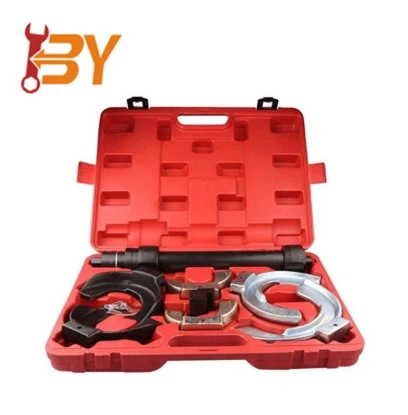
In automotive suspension repair, coil spring compressors are essential for safely removing and installing shock absorbers, struts, and coil springs.
These tools hold the spring under controlled compression, preventing sudden release of stored energy that could cause serious injury or damage.
While both hydraulic and manual spring compressors serve the same purpose, they differ significantly in operation, efficiency, and suitability for different types of workshops.
1. How Each Type Works
Manual Spring Compressor
A manual spring compressor typically uses a pair of threaded rods with hooks that attach to the outside of the spring. The user tightens each rod with a wrench or ratchet to gradually compress the spring.
Mechanism: Mechanical screw threads create compressive force.
Control: Relies on even manual tightening from both sides.
Power Source: None-fully manual operation.
Hydraulic Spring Compressor
A hydraulic compressor, on the other hand, uses hydraulic pressure to compress the spring smoothly and evenly. It may be a floor-standing unit, bench-mounted, or portable hydraulic press.
Mechanism: Hydraulic cylinder applies uniform pressure via pump or foot pedal.
Control: Precise, smooth, and effortless compression.
Power Source: Hydraulic fluid and pump mechanism.
2. Comparison: Hydraulic vs Manual
| Feature | Hydraulic Spring Compressor | Manual Spring Compressor |
|---|---|---|
| Force Output | High, consistent, and evenly distributed | Limited by manual torque |
| Efficiency | Fast operation, minimal effort | Slower, requires physical strength |
| Safety | Hydraulic system applies smooth pressure, reducing slip risk | Higher risk of uneven compression and hook slippage |
| Precision | Controlled via hydraulic pump, excellent balance | Depends on technician's skill and patience |
| Durability | Designed for frequent, heavy-duty use | Suitable for light to moderate use |
| Cost | Higher upfront investment | Low cost, budget-friendly |
| Best For | Professional workshops, fleet service, and heavy vehicles | Occasional repairs and small garages |
✅ Summary:
Hydraulic = Power, speed, precision.
Manual = Simplicity, portability, low cost.
3. When to Choose a Manual Spring Compressor
Manual spring compressors are ideal for:
Small workshops with low repair volume.
Occasional suspension work.
Lightweight springs (passenger cars, compact vehicles).
Mobile mechanics who need a compact, portable option.
However, technicians must tighten both sides evenly to avoid misalignment or slippage-a common cause of accidents.
4. When to Choose a Hydraulic Spring Compressor
Hydraulic compressors are the preferred choice for:
High-volume workshops handling multiple strut jobs daily.
Professional suspension service centers.
Heavy-duty or commercial vehicles with large, stiff springs.
Fleet maintenance where speed and safety are priorities.
Their hydraulic cylinders apply steady, controlled force, allowing precise compression without physical strain. This not only increases productivity but also minimizes the risk of spring deformation or technician injury.
5. Safety Considerations
Regardless of type, safety must always come first:
Inspect the tool before each use-never use bent or cracked components.
Lubricate threads (manual type) or maintain proper hydraulic fluid levels.
Position hooks evenly and compress springs symmetrically.
Always wear gloves and face protection.
Professional-grade compressors include safety locks, anti-slip jaws, and reinforced frames to further enhance protection.
6. Why Workshops Prefer Hydraulic Models
Most professional repair centers eventually upgrade to hydraulic spring compressors for three key reasons:
Speed: Compresses springs in seconds instead of minutes.
Safety: Even, controlled pressure eliminates common manual risks.
Efficiency: Reduces technician fatigue and increases daily job capacity.
The time saved per repair quickly offsets the initial investment.
7. Baiyu Tools' Professional Solutions
At Baiyu Tools, we design and manufacture a full range of hydraulic and manual spring compressors tailored for global workshops and distributors.
Our hydraulic compressors feature:
Forged steel construction for maximum strength.
Heavy-duty hydraulic cylinders rated for commercial use.
Dual safety locks and anti-slip jaws for technician protection.
Universal adapters compatible with MacPherson struts and coil springs.
OEM & ODM customization for distributors and tool brands.
Our manual compressors are built for affordability and reliability-perfect for smaller repair shops and mobile mechanics.
8. Conclusion
Both hydraulic and manual spring compressors have their place in modern workshops:
Choose a manual compressor for occasional use and light-duty jobs.
Choose a hydraulic compressor for frequent suspension repairs, heavy vehicles, or when efficiency and safety are top priorities.
In the long run, the hydraulic spring compressor is the smarter investment for professional workshops-it saves time, reduces risk, and delivers consistent results.
For distributors and repair centers seeking durable, high-performance solutions, Baiyu Tools offers reliable, precision-engineered spring compressors built to meet international standards of safety and quality.


